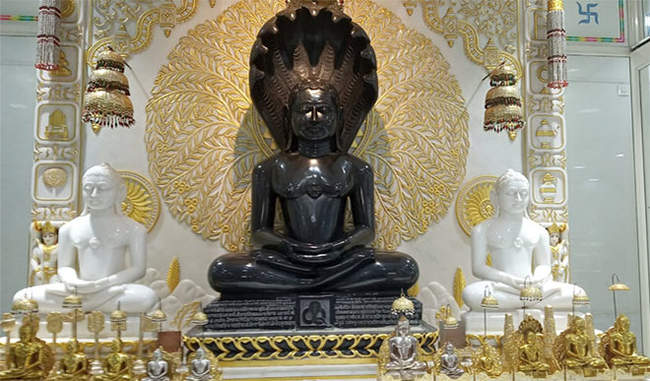
AhiṃsāNon-violence
The first and supreme vow — the renunciation of harm in thought, word and deed toward all sentient life. Reverence for the smallest creature is held as inseparable from reverence for the highest truth.
Chapter Two
Four eternal vows. One unwavering principle. A complete spiritual architecture for the conduct of a conscious life.
The teachings of Pārśvanātha are not, in the first instance, a cosmology to be debated nor a metaphysic to be parsed. They are a discipline of conduct — an architecture of how one breathes, eats, speaks, owns and acts in the presence of all that lives. From this disciplined conduct, the Jain tradition holds, an inward purification arises; and from that purification, the gradual exhaustion of karma and the awakening of the soul’s native, omniscient light.
At the heart of his teaching stands the Cāturyāma Dharma — the four-fold law — that organised the lives of his ascetics and householders alike. These vows are not negotiations with the world. They are reorientations of the self.
Cāturyāma Dharma
The original four-fold framework upon which Mahāvīra would later add the fifth distinct vow of Brahmacarya. Here is the moral foundation of the Jain way.
The first and supreme vow — the renunciation of harm in thought, word and deed toward all sentient life. Reverence for the smallest creature is held as inseparable from reverence for the highest truth.
The discipline of speech that is true, measured and beneficial. To speak falsely — even for advantage, even in jest — is to disturb the moral fabric of the world and to bind oneself further to karma.
To take only what is freely given. The vow extends beyond material possession to the subtler thefts of attention, time and credit — the appropriating of what was never offered.
The progressive release from grasping — material, emotional and intellectual. The vow does not condemn what one has, but the unconscious clinging by which one is, in turn, possessed by it.
Beyond the Vows
The four vows are the visible scaffold; behind them stands a coherent philosophy of consciousness, action and liberation that Pārśvanātha placed at the centre of Jain thought — a philosophy as relevant to the modern mind as it was to the ancient ascetic.
The conviction that every living being — from the largest mammal to the smallest microbe — possesses a soul capable of liberation, and is therefore deserving of unbroken reverence. Compassion is not sentiment; it is metaphysical recognition.
The systematic loosening of attachment to outcomes, identities and possessions — the inner discipline that allows the mirror of the soul to be wiped clean of the dust of grasping, and to reflect its own native luminosity.
Every action — bodily, verbal, mental — leaves a karmic residue that adheres to the soul and conditions its future. Liberation, in the Jain view, is not granted by deity but earned by the meticulous exhaustion of these accumulated bonds.
The final and absolute end of the soul's bondage to karmic matter — the realisation of its original, infinite knowledge, perception, energy and bliss. This is the destination toward which the entire ethical architecture of Pārśvanātha is oriented.
“Hurt no living being.— The Cāturyāma of Pārśvanātha, in Essence
Take only what is given. Speak only what is true.
Possess only what is needed. The rest is bondage.”
A Living Inheritance
Beyond the four vows, Pārśvanātha's order cultivated the temperament that would later flower into the full Jain doctrines of Anekāntavāda (the many-sidedness of truth) and Syādvāda (the conditioned predication of all assertion). The roots of these uniquely Jain contributions to Indian philosophy run back, through the Pārśvāpatya order, to the spiritual climate Pārśva established.
In an age that prizes certainty and the loud voice, his lineage offers a quieter and stranger gift: the recognition that truth is multi-faceted, that every assertion is partial, and that humility before the real is itself a form of reverence.